There is a specific kind of frustration reserved for the business owner who does everything right but remains unseen. You have spent years, perhaps decades, honing your craft. You have built a team of professionals, invested in a physical office in a prime location—whether that is a sleek consultancy in Singapore, a high-end clinic in Munich, or a law firm in Toronto—and yet, when you look at the Google Map Pack, your business is nowhere to be found. Instead, the top spots are occupied by competitors who you know, for a fact, provide inferior service.
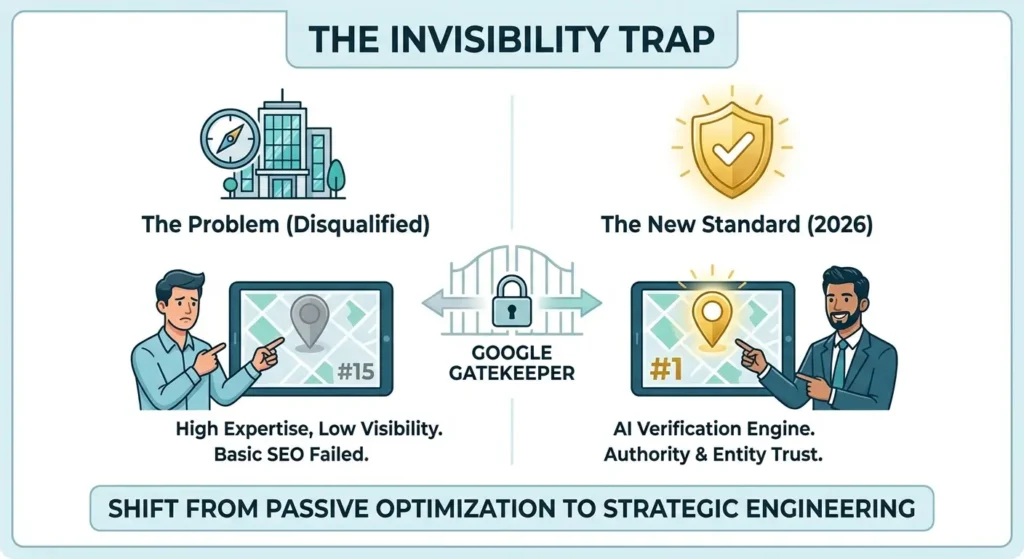
This is the Invisibility Trap. It is the silent killer of growth for established professionals. You are being punished not for a lack of expertise, but for failing to satisfy a machine that has become the world’s most powerful gatekeeper.
For years, the industry has fed you a lie. The “Lie of Basic SEO” suggests that if you just fill out your profile, add a few keywords, and get some five-star reviews, the algorithm will eventually reward you. That might have worked in 2018. In 2026, that approach is the equivalent of bringing a knife to a drone fight. The reality is that Google’s local search algorithm has evolved into a highly sophisticated AI-driven verification engine. It no longer rewards “presence”; it rewards Authority and Entity Trust.
Imagine the psychology of your potential client. They are in a state of urgent need. They pull out their phone, type in a service, and look at the first three results. In that split second, a massive amount of cognitive processing happens. They aren’t looking for the best business; they are looking for the “Safest” business. If you aren’t in those top three spots, you don’t even exist as an option for them. You have been disqualified before the race even began.
The frustration stems from the disconnect between your real-world authority and your digital shadow. You see a competitor ranking #1 simply because they have mastered a few technical loopholes or have a higher volume of generic reviews, and it feels like a personal insult to your professional integrity. It should. But getting angry won’t fix your ranking; understanding the new rules of the game will.
The 2026 standard for local dominance is about moving away from “marketing” and toward “strategic engineering.” We have to stop treating your Google Business Profile as a social media page and start treating it as a verified node in a global knowledge graph. This requires a shift from passive optimization to an aggressive, intelligence-led offensive. We are going to dismantle the barriers that are making you invisible and replace them with a technical and psychological framework that makes your business the only logical choice for both the algorithm and the human searcher. Your expertise deserves to be seen. It’s time to stop letting inferior competitors steal your market share.
Auditing the Mind of the Local Market
Before we touch a single technical setting, we have to perform a high-level “Digital Autopsy.” Most SEO agencies skip this because it requires more than just running a software report; it requires a psychological understanding of how your local market actually functions. This is the Intelligence Phase—the stage where we stop guessing what people want and start analyzing the behavioral data that drives their decisions. If you are a specialist in Istanbul, São Paulo, or Boston, your competition isn’t just “the other guy”; it is a set of entrenched consumer habits and algorithmic biases that we must systematically dismantle.
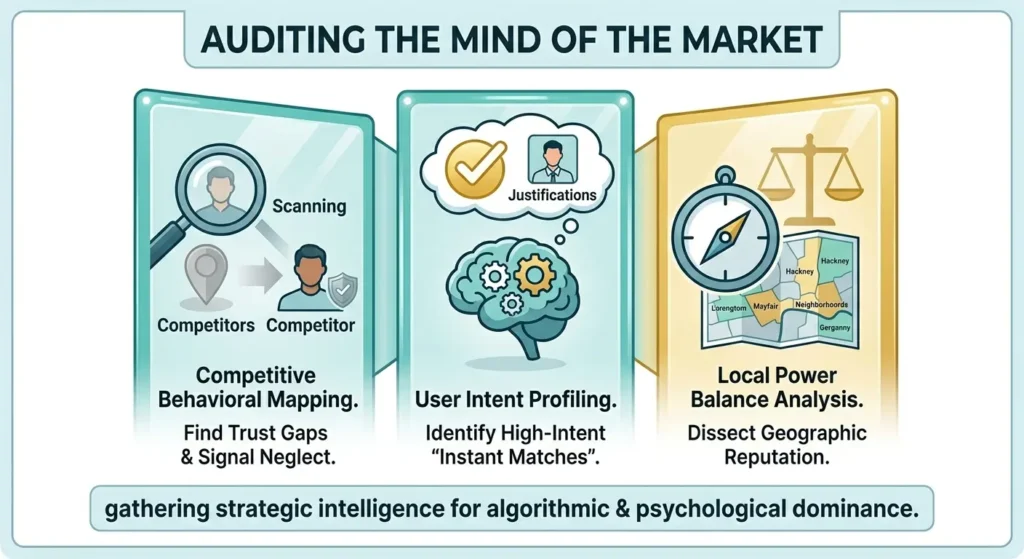
We start with Competitive Behavioral Mapping. I don’t just look at which keywords your competitors are using; I look at their “Operational Rhythm.” How do they respond to reviews? What kind of imagery do they use to signal authority? More importantly, I look for their “Psychological Vulnerabilities.” Often, a business that has sat at #1 for years in a city like Madrid or Seoul becomes complacent. They stop getting fresh reviews, their photos become outdated, and their Q&A section is a graveyard of unanswered queries. These aren’t just technical flaws; they are “Signals of Neglect.” To a human searcher, these signals create a subconscious feeling of distrust. To the 2026 algorithm, they represent a decline in “Vibrancy.” We find these openings and prepare to strike.
The second layer is User Intent Profiling. We have to ask: Why do people click? In a state of “High Intent,” the human brain relies on Heuristics—mental shortcuts used to make rapid decisions under pressure. When a user sees three options in the Map Pack, they are performing a lightning-fast “Risk Assessment.” They aren’t looking for the business with the flashiest logo; they are looking for the one that offers the least amount of “Cognitive Friction.” If your competitor has a “Justification” in their search result—a small snippet that says, “Known for expert technical consultations”—and you do not, the user’s brain has already chosen them. That snippet acts as a psychological “Instant Match.” Part of my audit is identifying which specific services you offer that have the highest “Search-to-Service Match” potential so we can force Google to display those snippets for you.
Finally, we analyze the Local Power Balance. Every neighborhood has its own digital gravity. In a city like London, the search behavior in Mayfair is fundamentally different from the search behavior in Hackney. The expectations of the clients are different, the pricing sensitivity is different, and the language they use to describe their problems is different. My “Psychologist” approach to auditing involves dissecting these local nuances. We look at the “Geographic Reputation” of your competitors. Are they seen as the “Expensive Authority” or the “Cheap Alternative”? Once we map the psychological landscape of your city, we can position you not just as “another option,” but as the definitive solution to the specific anxiety the searcher is feeling in that moment.
This phase is about moving from a “Generalist” mindset to a “Specialist” mindset. We are gathering the intelligence required to ensure that when we move into the technical execution, every move we make is designed to solve a problem that your competitors don’t even know exists. We are building a profile that doesn’t just satisfy a machine; it commands the attention of a human who is ready to buy.
2026 Standards and the Language of Authority
Once the psychological landscape is mapped, we move from the mind to the machine. In 2026, Google had moved past simple text matching. We are now operating in an environment of Verification-Based Search. The algorithm is no longer asking, “Who mentioned this keyword?” It is asking, “Which business can I mathematically prove is the most trusted and relevant entity for this user?” To answer this, we must build a technical engine that speaks the machine’s native language.
The cornerstone of this engine is the Digital Fingerprint, known in the industry as NAP (Name, Address, Phone). While it sounds simple, the execution in 2026 is a high-stakes operation of Data Synchronization. If your business in Doha, Amsterdam, or Cape Town has even a slight variation in its address across the web—if your website says “Floor 2” but an old directory says “Suite 200″—the algorithm detects a “Trust Gap.” To a machine, inconsistency equals risk. If it cannot verify your exact “Entity” status with 100% certainty, it will suppress your ranking to protect the user experience. My strategy involves a deep-tissue cleanse of the global data ecosystem. We don’t just fix your profile; we go to the Data Aggregators. These are the massive, silent warehouses of information that feed Google, Apple Maps, and even the navigation systems in high-end vehicles. By locking your data at the source, we create an unshakeable foundation of technical trust.
But the real “Secret Language” of 2026 is JSON-LD Schema. If your website is the book, Schema is the index that tells the machine exactly what every page means. Most agencies use generic, automated tags. I write custom, high-density Schema that identifies your business as a unique ProfessionalService entity. This code doesn’t just list your address; it embeds your exact latitude and longitude coordinates, your professional licenses, your primary service areas, and your connection to other verified entities. This creates a “Circle of Authority.” When a user in a specific district, such as Shibuya or Manhattan, performs a search, this code provides the “mathematical proof” that you are the closest and most relevant choice. It turns your business from a “possibility” into a “fact” within Google’s Knowledge Graph.
We also have to account for the rise of AI-Driven Verification via Vision AI. Google’s crawlers are no longer just reading your text; they are “viewing” your imagery. If you upload a photo to your profile, the AI scans it for signage, office environment, and even the presence of your team. This is why stock photos are now a ranking liability. My strategy involves a rigorous media protocol. We use professional photography that is stripped of irrelevant data and injected with EXIF Metadata. This hidden data layer contains your brand keywords and your precise GPS coordinates. When the Vision AI “sees” your signage and reads the embedded coordinates, it confirms your physical existence. This “Visual Proof” is a massive ranking factor that allows us to outpace competitors who are still relying on generic, unoptimized media.
Finally, we must address the shift toward Generative Engine Optimization (GEO). Search is moving away from a list of links toward a single AI-generated recommendation. To be the business that Gemini or ChatGPT recommends, we have to build Citation Density. This isn’t about the quantity of links, but the authority of the sources. We ensure your business is mentioned in high-level professional boards, local government registries, and city-specific news outlets. The AI looks for “Consensus”—it wants to see that multiple trusted sources agree you are the leader in your field.
By building this technical engine, we aren’t just “optimizing a profile.” We are constructing a high-performance digital infrastructure that forces the algorithm to recognize your authority. We are making your business machine-readable, verified, and impossible to ignore. This is the technical standard of 2026, and it is the only way to ensure that your expertise is translated into a dominant market position.
Winning the Radius War: Expanding Your Territory and Seizing Market Share
In local search, your biggest enemy is not a specific competitor; it is the Proximity Drop-off. This is the invisible wall that keeps your business from ranking once a user moves more than a few blocks away from your physical office. You might be the #1 professional when someone stands in your parking lot, but as soon as they move into the next district, you vanish. To dominate a city like Toronto, Paris, or Singapore, we must go to war with this radius. We do this by building Neighborhood Authority Silos—a technical and content-heavy offensive designed to trick the algorithm into seeing your business as a local fixture in areas where you don’t even have a desk.
Most agencies try to expand their reach by creating generic “service area” pages that Google’s AI easily identifies as “thin” or “spammy” content. My strategy is the opposite. We build high-authority landing pages that are hyper-localized. If your office is in a central hub, we create deep-dive resources for every surrounding neighborhood you want to conquer. These pages aren’t just about your services; they are about that specific neighborhood’s relationship with your industry. We mention local landmarks, transit routes, and regional professional standards. This tells the algorithm’s Language AI that you aren’t just “available” in that district—you are an expert of that district. By saturating your website with these “local signals,” we pull the algorithm’s trust outward, effectively stretching your ranking radius into territories where your competitors thought they were safe.
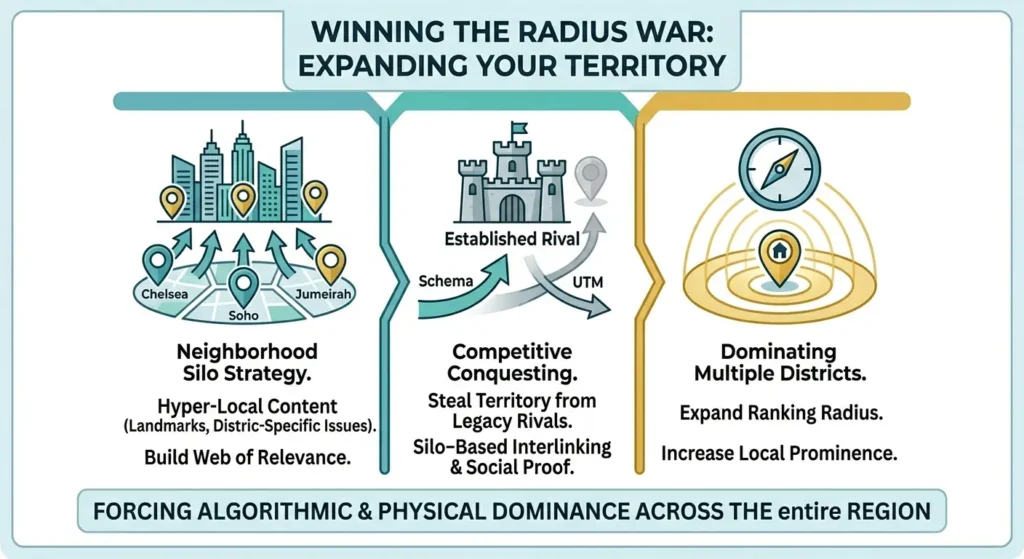
But expanding your radius is only half the battle; the other half is Competitive Conquesting. Every city has an established rival who has sat at the top of the map for years simply because they were there first. They have “Age Authority.” To unseat them, we use a technique I call Silo-Based Interlinking. We connect your neighborhood pages directly to your Google Business Profile using specific UTM tracking and Microdata. This creates a “loop of relevance.” When a user in a distant neighborhood clicks on your local page, it sends a powerful signal to Google: “This business is highly relevant to this specific location.” Over time, these signals accumulate, and the algorithm begins to prioritize you over the “legacy” competitor who has stopped working for their position.
We also weaponize Geo-Specific Social Proof. Most businesses get reviews from “anywhere.” We implement a system where we prioritize reviews from clients in your target expansion zones. When Google sees a cluster of reviews coming from a specific neighborhood—mentioning that neighborhood by name—it recognizes your “Physical Authority” in that zone. This is a massive ranking trigger. We aren’t just getting feedback; we are gathering “Geographic Votes of Confidence.”
This is the combat phase of SEO. It is about identifying the “soft spots” in your competitors’ territory and moving in with superior technical data and localized content. By building these silos, we are not just asking Google for permission to rank; we are proving that you are the most relevant choice for the entire city, not just your street. We are turning your single location into a regional powerhouse, ensuring that no matter where a high-value client is standing, your name is the first one they see.
The Conversion: Mastering the Psychology of the Click
Winning the ranking war is a hollow victory if it doesn’t result in a phone call. Ranking #1 is a technical achievement, but securing the click is a psychological one. Once your business is visible in the Map Pack, you are no longer competing with the algorithm; you are competing for the split-second attention of a human being who is looking for a reason to say “no.” In this state of high-intent search, the user’s brain is primed for Disqualification. They aren’t looking for the best option—they are looking for the “Safest” option. To ensure you are that choice, we must optimize for Cognitive Ease and Social Trust.
The first step in this psychological offensive is the removal of Cognitive Friction. When a user finds your profile in Dubai, London, or New York, their brain performs a lightning-fast audit. Is the “Call” button immediate? Are the hours clearly listed? Is there an unanswered question from three years ago sitting in the Q&A section? Any missing piece of information acts as a “Friction Point” that triggers a subconscious warning signal. My strategy involves a complete “Friction Audit” of your profile. We ensure that every button works, every question is answered with authority, and every service is clearly defined. We want the user’s journey from “discovery” to “contact” to be so smooth that their brain doesn’t have a single moment to hesitate.
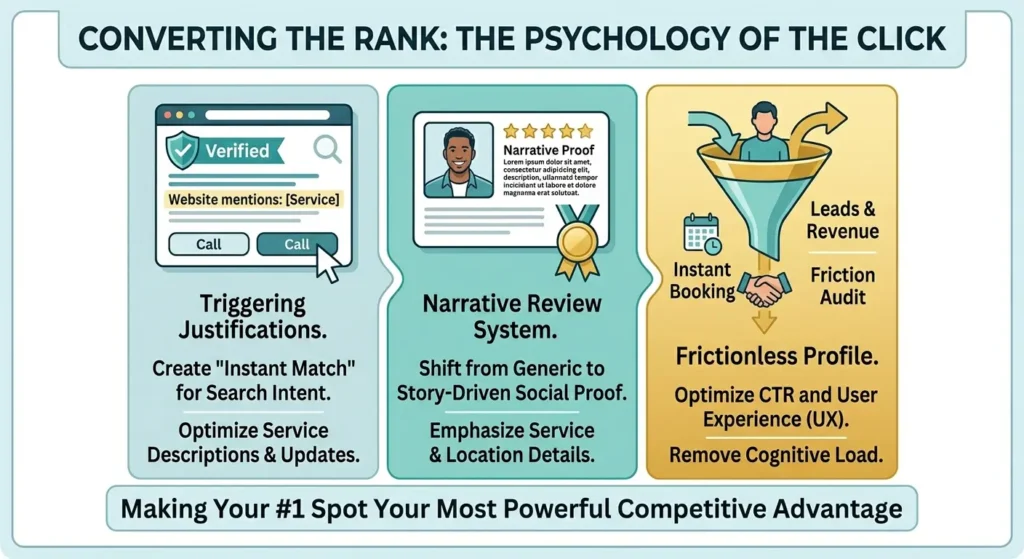
We then weaponize Review Narratives. Most agencies believe that a high star rating is enough. It isn’t. In 2026, both humans and AI models look for Semantic Depth in feedback. A review that says “Great service, 5 stars” is professionally “thin.” It provides no data to the machine and no reassurance to the human. We implement a system that guides your clients to provide “Narrative Proof.” We want reviews that describe the specific problem they had, the specific city they are in, and the specific relief they felt after working with you. When a potential client reads, “I was struggling with a complex technical audit in Berlin, and Anwar’s team solved it in 48 hours,” they see themselves in that success story. This is the ultimate psychological trigger; it moves the client from “skepticism” to “identification.”
Furthermore, we utilize Justification Loops to provide an “Instant Match.” Have you ever noticed how Google bolds certain phrases in the search results? This is a “Justification.” By structuring your profile’s “Updates” and “Services” using specific, problem-focused language, we force the algorithm to tell the user exactly what they want to hear. If a user searches for “high-stakes litigation” and your result explicitly states, “Their website mentions high-stakes litigation,” you have just bypassed their critical thinking. You have provided the “Correct Answer” to their internal question before they even clicked.
Finally, we address the Recency Bias. A business with 500 reviews from 2024 looks like a legacy brand that has peaked. A business with 50 reviews from the last 60 days looks like a market leader. We maintain a high Review Velocity to signal “Vibrancy” to the human eye. This constant stream of fresh, narrative-driven social proof creates a sense of momentum. It tells the user that you are not just an expert, but an active expert who is solving problems right now. By combining this psychological safety with technical dominance, we ensure that your #1 spot isn’t just a vanity metric—it is a conversion machine that turns searchers into loyal, high-value clients.
The ROI Framework: Measuring Success Beyond the Map Pack
The final stage of the Anwar Ali Framework is moving from execution to Accountability. In a world where agencies often hide behind “vanity metrics” like impressions and total clicks, we focus on the only data that matters: Revenue-Generating Actions. If your visibility in cities like Tokyo, San Francisco, or Zurich has increased, but your phone isn’t ringing, the strategy hasn’t fully landed. To bridge this gap, we implement a rigorous ROI Framework that tracks both the technical efficiency of the machine and the psychological conversion of the human searcher.
We start with High-Intent Action Tracking. Traditional SEO tracking is too broad; it tells you how many people saw your profile, but not why they were there. We filter your data to isolate “Discovery Actions.” These are instances where a user found you by searching for a specific service (e.g., “Complex Tax Audit”) rather than your business name. If your discovery percentage is rising, it proves that our Category Layering and JSON-LD Schema are successfully grabbing market share from competitors. We then map these discoveries to direct actions: phone calls, direction requests, and website clicks. This is the “Hard Data” that proves your digital asset is functioning as a lead-generation engine.
The second layer of our ROI analysis is Justification Performance. As we discussed, justifications are the snippets that prove relevance to the user. We monitor which of our “Service-Intent” descriptions are triggering these snippets. If our descriptions for “Consultancy” are triggering justifications but “Strategy” is not, we perform a Semantic Pivot. This level of granular tracking allows us to double down on what is working in real-time. It moves the project from a “set-and-forget” mentality to a “continuous optimization” model. We aren’t just looking for rankings; we are looking for the exact technical combinations that trigger a user to choose you over a rival in a high-stakes neighborhood like The Pearl or Rive Gauche.
Another critical metric is Radius Expansion Verification. We use localized search grids to see exactly where your “Ranking Bubble” stops. If we have built a Neighborhood Silo for a specific district, we expect to see a “relevance spike” in that geographic zone. If the data shows we are ranking in the center of Paris but failing in the outskirts, we adjust the EXIF Metadata and the local content density. This is how we prove that the “Radius War” is being won. We aren’t just telling you that you’re “ranking better”; we are showing you a heat map of your growing authority across the entire city.
Finally, we track the Social Proof Loop. We monitor Review Velocity and Semantic Depth to ensure that your “Psychological Authority” is maintaining its momentum. We look for a direct correlation between the freshness of your reviews and your “Click-Through Rate” (CTR). When the data shows that a fresh, narrative-driven review leads to a 20% spike in phone calls, we have the “Psychological Proof” that our conversion strategy is working.
This framework is designed to turn the “invisible” work of SEO into a visible, measurable business outcome. It provides you with a clear view of your Digital Market Share. By the end of this process, you no longer have to wonder if your investment is working. You have the data, the rankings, and—most importantly—the clients to prove it.