The Search Authority System:
The search economy of 2026 has transitioned from a retrieval-based model to a synthesis-based ecosystem, rendering traditional search engine optimization tactics not only obsolete but potentially liabilities to brand health. As an SEO strategist and Psychologist I approach this shift through the dual lens of technical architecture and clinical psychology. The fundamental challenge of modern search is no longer ranking for a keyword; it is the establishment of systemic authority that can satisfy the rigid logical requirements of generative reasoning engines while simultaneously resolving the deep-seated psychological uncertainty of the human user. The Search Authority System (SAS) is our proprietary response to this paradigm shift, a four-phase methodology designed to engineer trust, visibility, and conversion in an era where AI agents increasingly act as the primary gatekeepers of digital information.
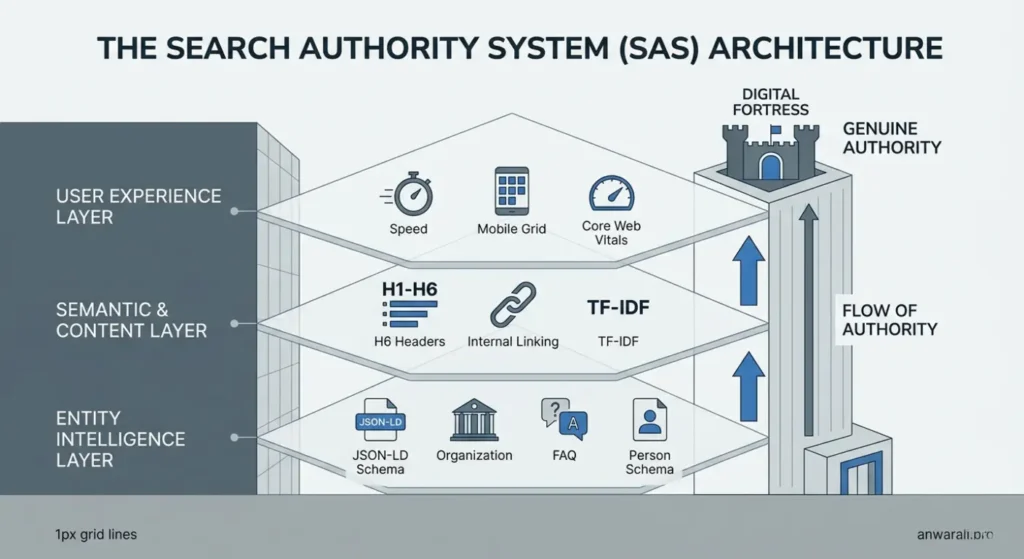
Table of Contents
The Neurobiology of the Search Query: Uncertainty and Self-Regulation
To understand search in 2026, one must first understand the clinical psychology of the searcher. From an evolutionary perspective, the human anxiety response serves as a biological signal detection system designed to prepare the individual for potential threats. In the digital context, a knowledge gap is processed as an environmental uncertainty, triggering a state of worry and apprehension that manifests both psychologically and somatically. Information-seeking behavior is, therefore, a self-regulatory mechanism utilized by the individual to reduce this aversive feeling of uncertainty and regain a sense of environmental control.
When a user enters a query—whether spoken into a voice assistant during a medical flare-up or typed as a complex, multi-part exploratory prompt—they are essentially seeking psychological “closure”. However, the modern web often produces “search-induced escalation” or “cyberchondria,” where fragmented, conflicting, and low-quality information heightens user distress. The Search Authority System addresses this by positioning the brand as the “familiar and authentic source of truth,” leveraging cognitive ease to shorten the path from high-arousal anxiety to low-arousal resolution.
| Psychological Construct | Digital Manifestation | SAS Strategic Response |
| Intolerance of Uncertainty (IU) | Hyper-specific, repetitive searching | Atomic Answer blocks for immediate closure |
| Paradox of Choice | Decision paralysis and cart abandonment | One-Decision Architecture to reduce cognitive load |
| Availability Heuristic | Preference for recognized, cited brands | Multi-platform citation velocity and brand consistency |
| Loss Aversion | Fear of making the “wrong” choice | E-E-A-T signals and verifiable expert credentials |
Phase 1: The Anti-Robot Firewall and the Information Gain Standard
The March 2026 Core Update served as a definitive turning point in how Google evaluates content quality, introducing what the industry has identified as the “Gemini 4.0 Semantic Filter”. This algorithmic gatekeeper is specifically designed to identify and demote content produced at scale through automated pipelines that lack meaningful human editorial oversight. In this landscape, the “Anti-Robot Firewall” is not a defensive barrier but a qualitative standard known as Information Gain.
The Information Gain Imperative
Information Gain is the primary ranking signal of 2026, measuring the degree of genuinely new data, first-hand experience, or proprietary insight a page contributes compared to existing results. Google’s systems have become intolerant of “scaled sameness”—content that covers the fundamentals but adds no unique value. The Search Authority System mandates that every high-priority asset must include “net-new” facts, such as internal data studies, subject matter expert interviews, or original graphics, to bypass these stricter semantic filters.
Algorithmic Decoupling of Parasitic SEO
A significant structural shift in 2026 is the decoupling of page-level authority from domain reputation. Historically, a “parasitic SEO” strategy allowed low-quality pages to rank by piggybacking on the trust of an authoritative domain. The March 2026 update implemented more aggressive independent page-level evaluation. A strong domain no longer protects weak filler content; every page must now serve as a functional node of authority or risk dragging down the entire site’s visibility.
Phase 2: Technical Deep-Dives and Cognitive Architecture
Technical SEO in 2026 is fundamentally an exercise in creating “cognitive ease” for both humans and AI agents. The tightening of Core Web Vitals (CWV) reflects a deeper algorithmic understanding of how performance impacts user satisfaction and engagement.
Core Web Vitals 2.0: The Performance Mandate
| Performance Metric | 2025 Standard | 2026 SAS Mandate | Psychological Impact |
| Largest Contentful Paint (LCP) | $\leq 2.5s$ | $\leq 2.0s$ | Perceived speed and initial trust |
| Interaction to Next Paint (INP) | $\leq 200ms$ | $\leq 150ms$ | Reduced frustration during interaction |
| Cumulative Layout Shift (CLS) | $\leq 0.1$ | $\leq 0.08$ | Visual stability and accidental click prevention |
| Time to First Byte (TTFB) | N/A | $\leq 600ms$ | Server-level authority and indexing priority |
The SAS architecture prioritizes Incremental Static Regeneration (ISR) and server-side rendering (SSR) for all critical factual passages, as many AI crawlers still struggle to execute complex JavaScript-heavy environments. By ensuring that 100% of high-value content is available in the raw HTML, we guarantee its accessibility to the RAG (Retrieval-Augmented Generation) pipelines that power AI Overviews and answer engines.
The Universal Commerce Protocol (UCP) Integration
As search evolves into “agentic commerce,” the definition of a website has shifted from a visual storefront to a structured data feed for agents. The Universal Commerce Protocol (UCP), co-developed by Google and Shopify, is the open standard that allows AI assistants to negotiate transactions directly with retail platforms.
The SAS technical implementation requires the hosting of a UCP manifest at /.well-known/ucp, declaring a site’s “Capabilities” (such as automated checkout or real-time catalog discovery). For a brand to remain “visible” in the agentic web, its data must be exposed via self-documenting APIs (OpenAPI/Swagger) and structured with the Model Context Protocol (MCP) to allow AI systems to query live source-of-truth data rather than relying on stale cached scraps.
Phase 3: Entity Mapping and the Psychology of Authority
In 2026, search engines do not just match strings; they comprehend things. Semantic SEO has become the standard for establishing “Entity Authority,” where a brand is recognized as a distinct, identifiably concept within Google’s Knowledge Graph.
Entity Salience and Topic Graph Construction
The Search Authority System utilizes advanced Topic Modeling to identify and bridge the gap between a brand’s primary entities and their “topical neighborhoods”. We measure Entity Salience—a score from 0 to 1 computed by the Natural Language API—to ensure that core business concepts are structurally prominent within the content ecosystem.
A successful SAS topic graph is built through “Nano-Clusters”:
- Pillar-Node Identification: Selecting a core entity that is broad enough to support depth but specific enough to be defensible (e.g., “AI SEO for B2B SaaS” instead of just “SEO”).
- Semantic Clustering: Developing 8-12 supporting cluster articles that cover co-occurring entities and concept relationships aligned with AI reasoning models.
- Bidirectional Linking: Implementing an internal linking system where pillar pages act as central hubs, and cluster pages reinforce subtopics, creating a topical signal graph that search engines can trust.
Author Entity Recognition and E-E-A-T Scoring
The March 2026 Core Update reported a 3.2x increase in the weight of E-E-A-T signals for YMYL categories. The “Search Authority” of 2026 is person-centric. We implement a rigorous “Author Entity Recognition” protocol, where credentials are cross-referenced across the web. Today, 89% of top-ranking results feature detailed author bios linked to comprehensive ProfilePage schema. Our system requires that every content creator has a verifiable digital footprint, including industry certifications, podcast appearances, and Wikidata associations, to ensure their expertise is machine-readable and defensible.
Phase 4: AI Optimization (AIO) and the “Share of Model” Metric
AI Overviews (AIO) and answer engines like Perplexity and ChatGPT Search have decoupled ranking from citation. A site may rank #1 in organic search but receive zero clicks if a competitor captures the AI Overview summary. The Search Authority System focuses on “Citation Velocity” and “Share of Model Influence” as the new KPIs of search success.
The Atomic Answer Framework for RAG Extraction
Retrieval-Augmented Generation (RAG) models parse content in 150-300 word chunks, placing the highest weight on the opening passage. The Search Authority System utilizes the “Atomic Answer” framework to ensure maximum extractability:
- Bottom Line Up Front (BLUF): Sections must begin with a direct, 40-60 word definitive statement that answers the implied question.
- Explicit Data Density: Integrating original statistics, numerical data tables, and specific named entities increases citation probability by up to 40%.
- Machine-Readable Syntax: Using subject-predicate-object structures and avoiding pronouns (e.g., “The Search Authority System reduces anxiety” instead of “It reduces it”) allows AI to map entity relationships with higher confidence.
| AIO Element | Specification | Strategic Value |
| Answer Blocks | 40-60 words, H2 question-header | Direct synthesis into AI snapshots |
| FAQ Schema | Nested JSON-LD, FAQPage type | 3.2x increase in citation lift |
| Information Gain | Proprietary internal metrics | Moat against automated AI competitors |
| Citation Velocity | Branded mentions on Reddit/X | Signals consensus and domain trust |
Reputation Risk and Narrative Stewardship
In 2026, AI search engines cite social platforms like Reddit, YouTube, and LinkedIn most frequently when synthesizing brand narratives. SEO has, therefore, evolved into “Narrative Stewardship,” where the brand’s expertise and terminology must remain consistent across the entire digital surface area. The Search Authority System monitors “Entity Sentiment,” identifying and resolving conflicts between a brand’s own claims and third-party entity profiles to prevent the algorithmic demotion that occurs when AI models encounter inconsistent training data.
The 2026 Search Roadmap: Algorithmic Calibrations
The strategic execution of SAS is informed by the overlapping algorithmic events of early 2026, which prioritize hyper-locality, predictive personalization, and the devaluation of sensationalism.
- February 2026 Discover Update: Introduced the “Home Turf Filter,” prioritizing country-specific publishers and institutional accounts on X.com as sources of timely, original content.
- March 2026 Core Update: Tightened CWV thresholds and formalized Information Gain as a primary ranking signal while decoupling parasitic SEO at the page level.
- April 2026 Search Console “Startup Edition”: Rolled out AI-backed positioning predictions and international site health dashboards, allowing for faster diagnostic responses to volatility.
- July 2026 Mobile Exclusion Deadline: Google has announced that sites without a functional mobile version will be excluded from the index entirely, moving from a ranking penalty to a complete removal mandate.
Positioning the Professional Solution: Why AnwarAli.pro?
While traditional agencies continue to offer siloed SEO or AI content services, anwarali.pro delivers the Search Authority System as an “integrated operating system” for business growth. Our approach is anchored in the clinical understanding of the user journey—a journey that often begins in a state of high-arousal uncertainty and ends when a brand provides the necessary cognitive ease to facilitate a decision.
The Anwar Ali “Think Local, Build Smart” philosophy ensures that technical decisions, such as the implementation of /.well-known/ucp As seen in the technical architecture of our site (anwarali.pro/.well-known/ucp), manifests or the development of “Nano-Clusters,” are always grounded in the ground reality of lead acquisition and revenue-relevant outcomes. We move beyond the “vanity metrics” of clicks and impressions to measure what truly matters: “Share of Synthesis” and “Assisted AI Conversions”.
In a search environment where 60% of queries end without a click, and where AI agents are the primary navigators of the web, the only sustainable strategy is the accumulation of systemic authority. The Search Authority System is that strategy—a comprehensive, future-proof framework for brands that refuse to be invisible in the generative era.
Conclusion: The Mandate for Behavioral SEO
The search landscape of 2026 represents the final convergence of machine intelligence and human psychology. The brands that dominate this new era will be those that understand search not as a technical problem to be solved, but as a behavioral need to be fulfilled. By integrating the “Anti-Robot Firewall” of Information Gain, the “Cognitive Architecture” of CWV 2.0 and UCP, and the “Psychological Anchoring” of Entity Authority, the Search Authority System provides the only viable path to long-term organic dominance.
The transition from documents to concepts, from keywords to entities, and from browsers to agents is no longer theoretical—it is the operational reality. For the enterprise seeking search market leadership, the mandate is clear: build authority as a system, or face the certainty of synthetic invisibility